Labels

Showing posts with label Research. Show all posts

Friday, 15 March 2013

Film production and distribution research

Dream Works Studios

Dream works was founded on 12th October 1994 and is based in California, United States. The founders of the is company Steven Spielberg, Jeffery Katzenberg and David Geffen. It produces and distributes films. Toy story was their highest grossing film, it grossed $1,063,171,911. They tend to produce animated films aimed at mostly children. 


20th Century Fox

20th Century Fox was founded 31st May 1935, by merger of Fox Films (founded in 1915) and 20th Century Pictures, Inc. (founded in 1933). The founders of the company were Joseph Schenck and Darryl. F Zanuck. The company produces as well as distributing films. Their highest grossing film is Avatar.


Working Title

Working Title is a production company that was founded in the year 1983 and is in the industry of film production. Tim Bevan, Sarah Radclyffe, Eric Fellner, Liza Chasin, Debra Hayward and Natascha Wharton are the key people involved with the company and its headquarters is in London, United Kingdom. Its highest grossing film is Bridget Jones' Diary with $281,929,795. They commonly produce comedy and romantic comedies.


Universal Studios

Universal Studios was founded in 1912 by Carl Laemmle, Pat Powers, Mark Dintenfass, William Swanson, David Horsley, Charles Baumann, Adam Kessel and Jules Brulatour. It is one of the longest-lived motion picture studios to be located outside of Hollywood. It is a part of the American media conglomerate NBCUniversal and subsidary of Comcast.


Thursday, 17 January 2013

After Effects Test

My first attempt on After Effects, I found quite enjoyable and inspiring as it could potentially help my film significantly. However, as I am new to the facility it mat take me some time to adapt to the way it functions.


Sunday, 2 December 2012

Practicing Credits Timeline


As practice my group and I constructed a credits timeline for the film Juno. This gave us the understanding and experience in order create our own timeline successfully and in the correct format.

Saturday, 20 October 2012

Explanation of 180 degree rule


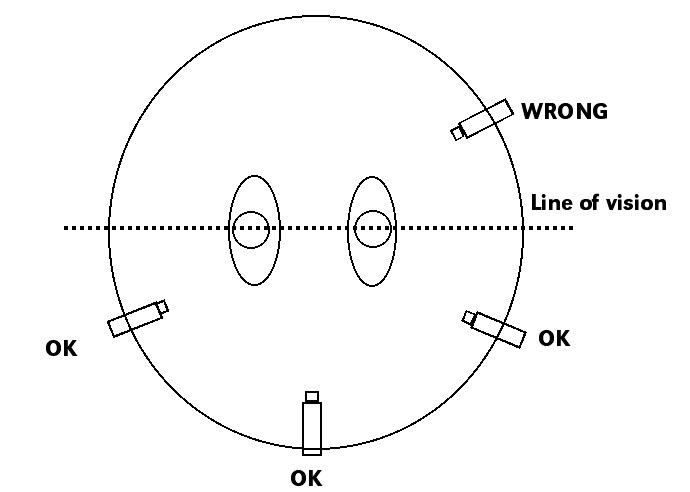
The 180 degree rule is a basic yet vital guidline used in film-making, concerning a character and another or chharacter and an object in a scene. There is an imaginary line called the axix (as shown in the diagram), and by keeping the camera on only one side of the line in every shot in the scene, the first character will always be on the right side of the frame and the second will always be on the left side of the frame. This is often the case when when two people are exchanging dialogue. If the camera was to cross the line at any time during the scene then this would be called crossing the line or jumping the line.This rule helps the audiencce visually connect with the film and if broken this can not only cause confusion but also reduce the quality of the shot and scene.


I have carried out some research into finding an example of the 180 degree rule. The images below displays a common situation where it would be used. Image 1 displays a two shot, usually used to establish the scene and make the audience aware of the characters and settings in the scene. Image 2 shows an 'over the shoulder' shot, commonly used to show one character talking to another, allowing the audience to see their emotions and reactions, this technique conforms the 180 degree rule, as shown in the image the camera does not cross the imaginary line. Image three shows another example of an 'over the shoulder shot' however the camera is focused on the other character, however still follows the guidelines of the 180 degree rule.


Image 1

Image 2


Image 3